A printer planning its next paperboard or commercial-printing order may be asked to reduce mineral-oil content, document chemical compliance, or provide stronger evidence for sustainability claims. Choosing an ink supplier based on a “green” label alone can leave purchasing teams without enough information to answer customers or verify a product’s fit for their press. In 2026, we recommend treating sustainability as a set of measurable product and process requirements, not a broad marketing promise.
At Hypertai, we help overseas printing businesses compare ink options against substrate, printing method, finishing requirements, and target-market documentation. A supplier should explain what a formulation changes, what evidence supports the claim, and which limitations still apply. These checks are especially relevant when comparing oil-based ink with mineral-oil-free alternatives or planning eco-friendly printing for packaging and publications.
Define What “Eco-Friendly” Means for Your Application
Start by identifying the issue your business needs to address: reducing mineral-oil content, checking volatile organic compound (VOC) information, meeting restricted-substance requirements, or satisfying target-market rules. These goals differ, so ask which formulation feature or tested property supports each claim. For products marketed to EU consumers, Directive (EU) 2024/825 applies from 27 September 2026 and restricts certain generic environmental claims that lack recognized substantiation.
We advise buyers to request measurable details rather than relying on broad terms such as “green” or “environmentally friendly.” For oil-based ink, ask which oils and solvents are used and whether the supplier offers a mineral-oil-free alternative. For eco-friendly printing, also consider process waste, cleaning requirements, drying performance, and whether the change affects rejected sheets or energy use.
Verify the Technical Documents and Compliance Claims
A dependable supplier should provide an up-to-date technical data sheet, safety data sheet, and clear guidance on intended applications, handling, storage, and press conditions. Depending on the job, you may also need a declaration addressing specific restricted substances, test results, or details that support customer audits. Check product names and formulation versions so the documents actually match the ink being quoted.
For export work, check requirements by destination and end use; one certificate may not cover every market. In 2026, the European Printing Ink Association (EuPIA) introduced its voluntary Charter on raw-material selection and exclusion. Individual companies commit to its principles, so it is not an automatic certification for every product. Food-packaging applications need product-specific information and checks of the complete packaging construction and intended contact conditions.
Match the Ink to Your Press and Substrate
An environmentally focused formulation still needs to run reliably on the intended equipment. Paper grade, coating, ink-water balance, setting time, color requirements, and finishing operations can all affect performance in sheet-fed offset. A substitute oil-based ink may behave differently from the current product, even when both are designed for similar applications. Supplier recommendations should therefore refer to your actual stock and press setup, not only to a general product category.
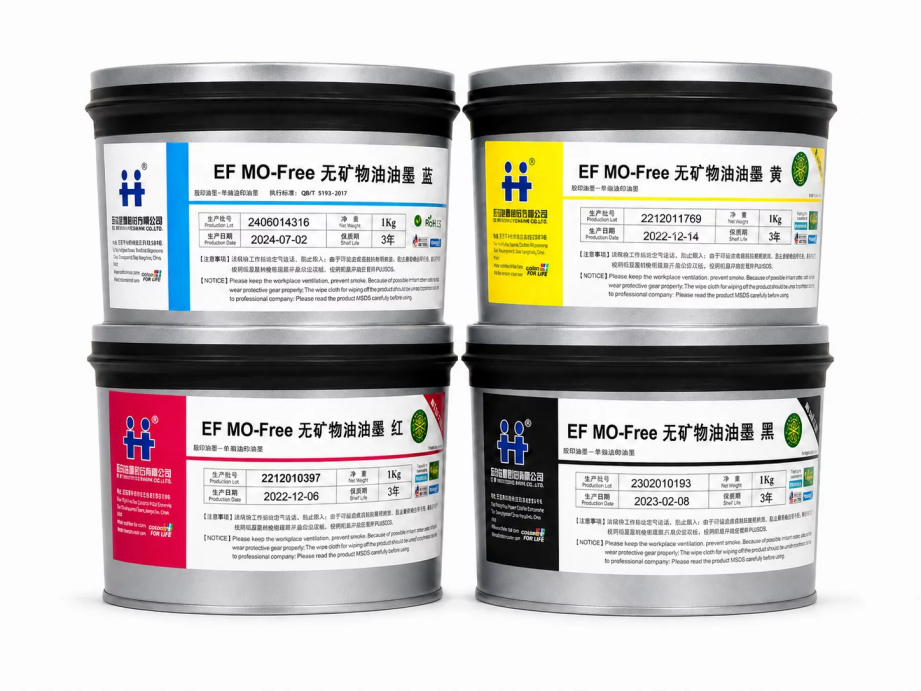
Hypertai lists conventional sheet-fed offset choices as well as mineral-oil-free options in its oil-based and mineral-oil-free offset ink portfolio. Its EF MO-FREE Series is described as a vegetable-oil-based, mineral-oil-free offset ink for applications including packaging and publications. We recommend confirming the precise stock, print process, and required documentation before deciding whether it fits your eco-friendly printing goals.

Test Print Quality and Repeatability Before Switching
A brochure, carton, or publication needs predictable color and a surface that can withstand the planned finishing and handling. Before approving a supplier, compare color reproduction, ink-water balance, setting, rub resistance, and the behavior of printed sheets during folding, cutting, stacking, or coating. A short sample run is useful, but production-representative testing offers stronger evidence when volumes and conditions differ from a laboratory sample.
We suggest recording the current ink’s baseline, agreeing on acceptance criteria with the prospective supplier, and trialing the alternative on the actual substrate. Check whether operators need different settings and whether the ink changes waste levels or turnaround time. That process gives a more reliable basis for choosing oil-based ink or a mineral-oil-free product than a brochure claim alone, and helps buyers assess eco-friendly printing in practical terms.
Evaluate Communication, Traceability, and Supply Continuity
Product performance is only part of supplier reliability. Purchasing teams also need clear lead times, consistent batch identification, notice of formulation changes, and a route for resolving technical issues. Ask how the supplier handles complaints, documents a root-cause investigation, and communicates when a product or raw material changes. These details matter when a packaging customer requires repeatable color or traceable production records across orders.
At Hypertai, we support overseas customers with product matching, technical communication, and sample coordination. During supplier evaluation, we recommend checking whether the team can explain product limits plainly and help compare alternatives for your process. A useful supplier relationship should make it easier to maintain agreed specifications—not leave press operators to solve recurring problems alone.
Make the Final Selection a Documented One
Choosing a reliable supplier ultimately comes down to what you can confirm in writing and on the press, not what a brochure promises. An oil-based ink or mineral-oil-free option should be matched to the actual substrate and finishing process, then trialed for eco friendly ink printing before it replaces the current product. Share your application and market details with Hypertai to review product information and build a documented basis for your decision.