A printed card has to do more than look sharp as it leaves the press. During converting, personalization, packing, shipping, and everyday handling, its printed surface may experience rubbing, bending, stacking pressure, or contact with other materials. When the ink film does not bond appropriately, graphics can scratch, lift, or crack, creating rejected cards and extra inspection work.
For manufacturers running repeat orders, an adhesion problem can also mean that a previously approved color and finish are no longer reliable in production.
At Hypertai, we recommend treating ink selection as part of card construction rather than a standalone purchase. The substrate, surface coating, curing setup, and expected use all influence how a UV curable ink performs. By understanding these connections before a full production run, buyers can set more useful acceptance criteria, choose the right tests, and discuss product suitability with their ink supplier.
Adhesion Protects Print Quality Through Handling
Card graphics, fine text, logos, and security-related visual elements need to stay legible after printing and downstream handling. If the ink film attaches poorly to the surface, friction or contact with adjacent cards can cause scuffing, flaking, or image transfer. Even when the defect affects only a small area, it may compromise appearance and lead to sorting or reprinting costs.
Good UV ink adhesion helps the printed layer remain attached when the card moves through normal production and use. We encourage card manufacturers to define the expected performance based on the end product: a membership card, gift card, hotel key card, or specialty promotional card may face different levels of abrasion and handling. Test the actual printed construction, not just a flat sample that has not been converted.

The Card Substrate Determines the Starting Point
Cards may use PVC or other plastic materials, synthetic stocks, coated paper, or layered constructions. These surfaces differ in surface energy, additives, coatings, and texture, all of which can affect how ink wets and bonds. A blank that looks clean may still carry a coating or residue that interferes with printing, while two materials sold under a similar label may respond differently to the same formulation.
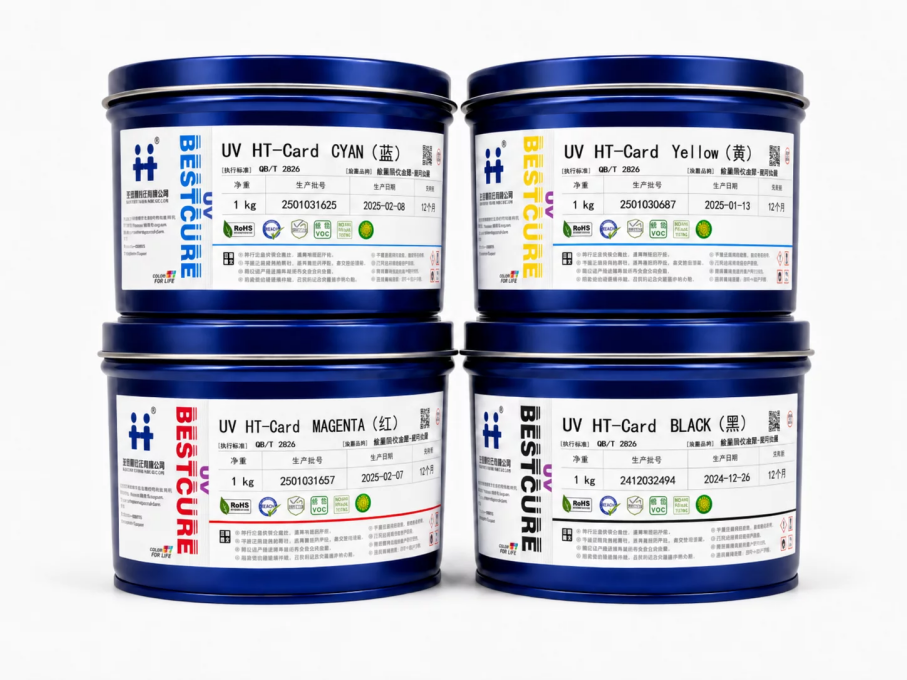
Before choosing a UV curable ink, we recommend confirming the exact card material, surface treatment, and any protective topcoat. Hypertai’s UV HT-Card Series is described as a high-grade UV curable ink for coated paper, metallized paper, synthetic paper, and other non-absorbent materials, including selected card and specialty print applications. That range is a useful starting point, but the actual card stock still needs to be tested and approved.
Curing and Adhesion Are Related but Different
UV curing transforms a liquid ink film into a solid layer when it receives suitable UV energy. Lamp output, wavelength, press speed, pigment loading, and ink-film thickness may influence whether the film cures as intended. Inadequate curing can leave the surface more vulnerable to marking or reduced resistance, but curing alone does not guarantee that the ink has bonded well to the card beneath it.
When UV ink adhesion is weak, we advise checking whether the UV curable ink matches the surface and curing conditions before changing settings. Check that the ink is compatible with the UV source, review the equipment settings, and inspect how the ink wets the blank before curing. Hypertai lists the UV HT-Card Series as a budget-friendly UV curing ink for general packaging and commercial runs, combining medium-speed drying with excellent film flexibility, solid ink-substrate bonding, and dependable rub resistance ; confirm those characteristics under your production conditions.
Flexibility Matters During Converting and Use
A card’s printed surface may experience pressure, rubbing, bending, trimming, or other mechanical stresses depending on its design and production route. If a cured ink film is too brittle for the substrate and the stress applied, fine lines or solid areas may crack or chip. This risk is relevant where the printed layer must remain intact through die-cutting, embossing, lamination, or repeated handling.
We recommend checking flexibility as part of the finished-card test plan, alongside adhesion and abrasion resistance. The UV HT-Card Series is described by Hypertai as offering film flexibility for card and specialty-print applications. Rather than assuming the ink will suit every card construction, verify the result after the intended converting steps and use conditions. That makes product selection more evidence-based and can reduce late-stage surprises.
Build Testing Around the Real Production Job
A sample that looks good immediately after printing does not prove long-term performance. Card manufacturers should assess the print after the ink has cured and the sample has gone through relevant handling, stacking, packing, or finishing. Depending on the product specification, checks may include a tape-pull or cross-hatch adhesion test, rub testing, scratch resistance, and inspection for cracking or image transfer. Use consistent methods and pass criteria so results can be compared between suppliers.
At Hypertai, we encourage customers to share the substrate, printing method, UV equipment, and end-use requirements before requesting a recommendation. Our team can help identify a suitable product for evaluation, but the final acceptance decision should come from a controlled trial on production-representative cards. Record the ink batch, curing settings, substrate lot, and test outcome so the result can be reproduced during later orders.
Treat Adhesion as a Requirement, Not an Afterthought
Adhesion is easiest to get right when it is treated as a card-building requirement rather than checked after printing. For manufacturers, that means defining the expected handling, choosing a UV curable ink that matches the actual stock, and confirming the result on production-representative cards before committing to a full run. Hypertai’s UV HT-Card Series is one option for card and specialty-print work. Share your substrate and end-use requirements with our team to arrange a representative sample trial.