Food packaging buyers are being asked to balance print quality, production efficiency, chemical documentation, and environmental objectives. A folding carton may not touch food directly, yet substances from printed surfaces can sometimes transfer through set-off, packaging layers, or recycled fiber. Choosing an ink based only on a “green” label can leave important questions unanswered, especially when the package will be used in a regulated market.
At Hypertai, we encourage converters to define the packaging use and evidence requirements before comparing formulations. A mineral oil-free ink can address one specific concern, but it does not independently demonstrate that the finished package is suitable for every food application. We recommend reviewing the entire printed structure, supply-chain documentation, and process conditions before selecting an environmentally friendly printing ink.

Define the Environmental Goal Before Comparing Inks
“Environmentally friendly” can refer to different objectives: limiting mineral-oil content, reducing certain solvents, selecting renewable raw materials, improving production efficiency, or supporting recycling. These are not interchangeable claims. Begin by identifying the requirement from your customer or market, then ask how the ink’s formulation or documented performance addresses it. This keeps purchasing decisions tied to measurable needs instead of broad descriptions.
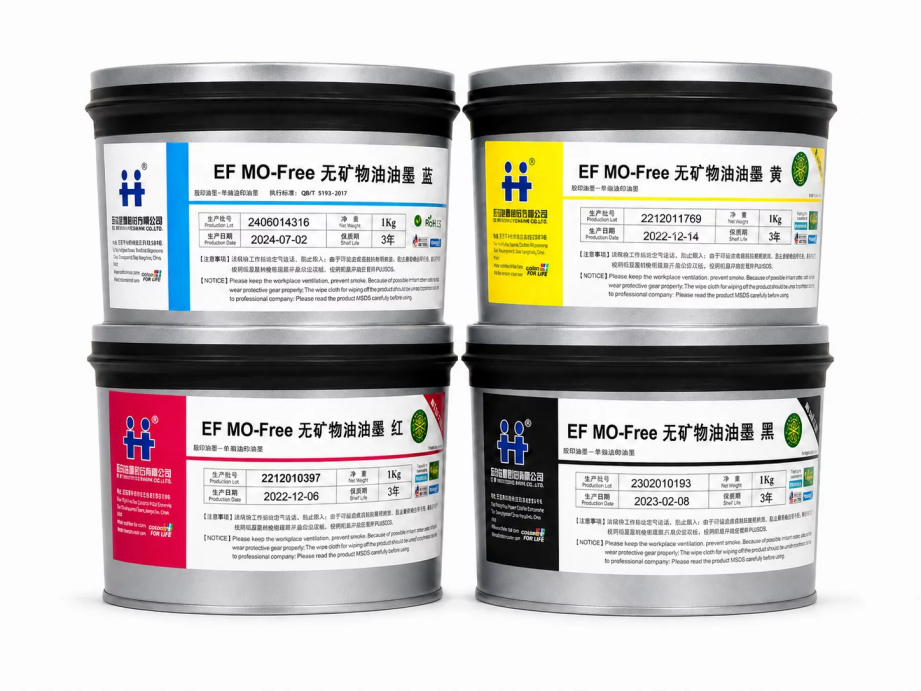
For paperboard cartons and publications, a mineral oil-free ink may be relevant when a customer wants to reduce mineral-oil sources in printed material. Hypertai’s EF MO-FREE Series is described on its product page as a vegetable-oil-based offset ink with no petroleum-based solvents added. We suggest reviewing the current specification and confirming exactly which formulation claims apply to the product being quoted.
Treat Food-Contact Suitability as a Packaging-System Question
Ink selection is only one part of food-packaging risk assessment. Consider whether the printed area faces food, the barrier properties of the substrate, possible set-off during stacking, intended storage conditions, and the food type. Even when printing occurs on the non-food-contact side, migration and contamination risks need to be evaluated for the finished packaging construction and its actual use.
The European Printing Ink Association (EuPIA) explains that food-packaging compliance involves information-sharing across the supply chain, risk assessment, and good manufacturing practices. In the EU, Regulation (EC) No 1935/2004 provides the framework for food-contact materials, while Regulation (EC) No 2023/2006 addresses good manufacturing practice. A mineral oil-free ink should therefore be reviewed alongside the substrate, coatings, adhesives, and converter’s process—not treated as a stand-alone guarantee.
Verify the Formulation and Supporting Documents
Ask the supplier for an up-to-date technical data sheet, safety data sheet, and application guidance. For relevant food-packaging uses, also ask what information is available to support migration assessment, including statements of composition or other product-specific compliance information where appropriate. Confirm that names, versions, and intended applications match the exact ink being purchased, particularly when a supplier offers several related formulations.
Hypertai states that its EF MO-FREE Series uses vegetable oils, contains no added petroleum-based solvents, and is formulated to meet French restrictions relating to MOAH/MOSH content. Its published information also lists claims concerning PFAS, cobalt-based drying agents, REACH, RoHS, and EN 71-3. These are specific product-page statements, not a blanket food-contact approval. We recommend requesting applicable supporting documents and checking their scope with your packaging compliance team.
Match Ink Performance to the Press and Substrate
A formulation with a preferred ingredient profile still needs to print consistently on the intended stock. Paper coating, absorbency, ink-water balance, color requirements, setting time, and downstream finishing can affect results. A mismatch may cause slow setting, marking, color changes, or additional waste, which can undermine both productivity and sustainability objectives. Test with the actual board grade and production conditions rather than relying only on a sample printed elsewhere.
We recommend trialing the proposed environmentally friendly printing ink on representative equipment and assessing color, setting, rub resistance, and behavior during folding, cutting, or coating. Hypertai lists EF MO-FREE among its sheet-fed and mineral-oil-free offset ink solutions for packaging and publications. Ask the team to confirm suitability for your press and substrate, then document the approved settings and acceptance criteria before switching regular production.
Check Environmental Claims and Supplier Transparency
Reliable sourcing includes knowing the boundaries of each environmental claim. “Mineral oil free” does not automatically mean low-carbon, recyclable, compostable, or compliant for direct food contact. Ask for evidence for each claim you intend to communicate to customers, and avoid carrying a formulation statement over to the full package unless the complete construction has been assessed. Consider ink waste, cleaning, rejected sheets, and production energy when comparing overall process impact.
EuPIA’s risk-assessment and migration guidance emphasizes potential migrants, non-intentionally added substances, and the importance of assessing the specific packaging application. We suggest choosing suppliers who can explain documentation clearly, identify the product version covered, and respond to technical questions. That approach helps buyers evaluate a mineral oil-free ink on evidence rather than assumptions and keeps environmental messaging specific and defensible.
Put the Final Choice Through a Production Trial
Choosing an environmentally friendly printing ink for food packaging ultimately means confirming how the ink, substrate, and finished carton work together under real production conditions. A mineral oil free ink such as Hypertai’s EF MO-FREE Series can be a suitable starting point for vegetable-oil-based offset work, but the decision should rest on verified documents and a controlled trial run on your actual board, packaging structure, and intended market before you commit to regular production.